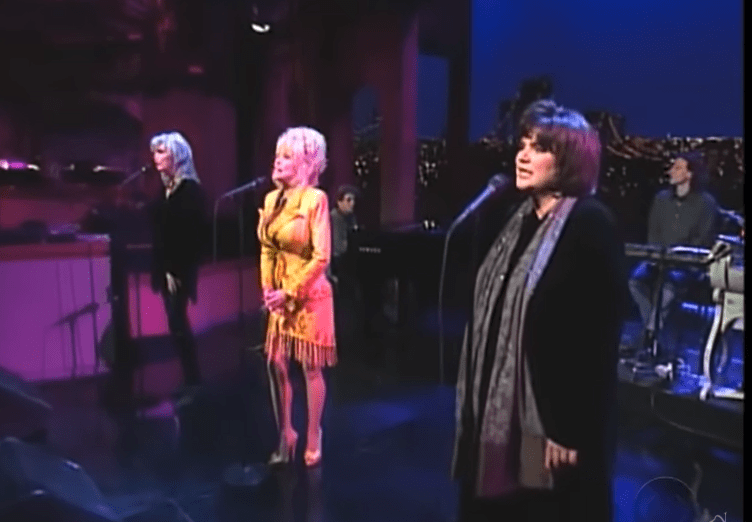
“Trio II” was recorded in 1994 but not released until 1999, when Emmylou Harris, Dolly Parton, and Linda Ronstadt appeared on Late Show to perform Neil Young’s “After the Gold Rush.” The Glass Harmonica (or Armonica) was played by Dennis James, who remembers the performance in an interview with Rich Bailey in 2002: Rich Bailey: I remember when you appeared with her on Letterman and you discussed the Armonica a bit. How was that? Dennis James: Well, it was a great surprise. A sort of unspoken message in the air to me before the broadcast was “Do not say anything on the air!”. After all, these things are Linda’s appearances. When David L. leaned over his desk and directed a question to me I simply froze- on playback of the dub I can see myself caught and unable to speak. I received a glance from Linda that said to me it was OK and so when he tried again I called back a flip one liner and on things went from there. http://www.ronstadt-linda.com/djames…. The synthesizer player is Cliff Carter. I think the pianist is Robbie Kondor. The Trio altered two lines in their original “Trio II” recording: 1. “in the nineteen seventies” changed to “in the twentieth century.” 2. “And I felt like getting high” changed to “And I felt like I could cry.” Here’s their CD version: https://www.youtube.com/watch?v=ykMzS… It’d be tough to imagine them changing the lyrics without first getting Neil’s permission. So to everyone complaining about the lyric changes in this live performance: Don’t blame the show or the network. The changes had been made in the Trio’s original recording. And, we must assume, with Neil Young’s blessing. Update: Quoting Wikipedia: “Parton also released a solo version of the song in 1996, though her version altered the line ‘I felt like getting high’ to ‘I felt like I could cry’ with the permission of Neil Young.”
“Trio II” was recorded in 1994 but not released until 1999, when Emmylou Harris, Dolly Parton, and Linda Ronstadt appeared on Late Show to perform Neil Young’s “After the Gold Rush.” The Glass Harmonica (or Armonica) was played by Dennis James, who remembers the performance in an interview with Rich Bailey in 2002: Rich Bailey: I remember when you appeared with her on Letterman and you discussed the Armonica a bit. How was that? Dennis James: Well, it was a great surprise. A sort of unspoken message in the air to me before the broadcast was “Do not say anything on the air!”. After all, these things are Linda’s appearances. When David L. leaned over his desk and directed a question to me I simply froze- on playback of the dub I can see myself caught and unable to speak. I received a glance from Linda that said to me it was OK and so when he tried again I called back a flip one liner and on things went from there. http://www.ronstadt-linda.com/djames…. The synthesizer player is Cliff Carter. I think the pianist is Robbie Kondor. The Trio altered two lines in their original “Trio II” recording: 1. “in the nineteen seventies” changed to “in the twentieth century.” 2. “And I felt like getting high” changed to “And I felt like I could cry.” Here’s their CD version: https://www.youtube.com/watch?v=ykMzS… It’d be tough to imagine them changing the lyrics without first getting Neil’s permission. So to everyone complaining about the lyric changes in this live performance: Don’t blame the show or the network. The changes had been made in the Trio’s original recording. And, we must assume, with Neil Young’s blessing. Update: Quoting Wikipedia: “Parton also released a solo version of the song in 1996, though her version altered the line ‘I felt like getting high’ to ‘I felt like I could cry’ with the permission of Neil Young.”
“Trio II” was recorded in 1994 but not released until 1999, when Emmylou Harris, Dolly Parton, and Linda Ronstadt appeared on Late Show to perform Neil Young’s “After the Gold Rush.” The Glass Harmonica (or Armonica) was played by Dennis James, who remembers the performance in an interview with Rich Bailey in 2002: Rich Bailey: I remember when you appeared with her on Letterman and you discussed the Armonica a bit. How was that? Dennis James: Well, it was a great surprise. A sort of unspoken message in the air to me before the broadcast was “Do not say anything on the air!”. After all, these things are Linda’s appearances. When David L. leaned over his desk and directed a question to me I simply froze- on playback of the dub I can see myself caught and unable to speak. I received a glance from Linda that said to me it was OK and so when he tried again I called back a flip one liner and on things went from there. http://www.ronstadt-linda.com/djames…. The synthesizer player is Cliff Carter. I think the pianist is Robbie Kondor. The Trio altered two lines in their original “Trio II” recording: 1. “in the nineteen seventies” changed to “in the twentieth century.” 2. “And I felt like getting high” changed to “And I felt like I could cry.” Here’s their CD version: https://www.youtube.com/watch?v=ykMzS… It’d be tough to imagine them changing the lyrics without first getting Neil’s permission. So to everyone complaining about the lyric changes in this live performance: Don’t blame the show or the network. The changes had been made in the Trio’s original recording. And, we must assume, with Neil Young’s blessing. Update: Quoting Wikipedia: “Parton also released a solo version of the song in 1996, though her version altered the line ‘I felt like getting high’ to ‘I felt like I could cry’ with the permission of Neil Young.”
Album ” Ceol 06 ” Uisce a’ teacht a’ breathnú orm Ag fanacht siar Ag fanacht siar ar dhuine Uisce a’ teacht a’ breathnú orm Ag feitheamh, ag feitheamh ar dhuine éigin. Ós do chomhair an saol ‘tá thart Is mise tréigthe san am fadó Ag caitheamh ama go mall réidh Ag fiafraí díom “Cén fáth, cén fáth?” Ar chuaigh siad thart i ngan fhios dom Nó an dall atáim? De bharr an t-uisce … Ní fhacamar an téacs bhí romhainn Níor thomhaiseamar céard bhí le teacht Ag sciobadh linn aislingí ár dtodhchaí Is chuireamar amach faoin ngrian iad Nocht, mar rabhchán do ‘chuile dhuine A rinne faillí Tar a mhic, is mar seo atá sé Mar chailín cúthail faiteach Nó athrú aimsire geimhridh Mar chúis le briseadh chroí Is a bhanríon mo chroí Le mo smaointe aoibhne áille Imithe i bhfad uaim Is mé buartha le h-Uisce a’ teacht… Is mé ag feithimh Ag feitheamh Le banríon mo chroí
“Trio II” was recorded in 1994 but not released until 1999, when Emmylou Harris, Dolly Parton, and Linda Ronstadt appeared on Late Show to perform Neil Young’s “After the Gold Rush.” The Glass Harmonica (or Armonica) was played by Dennis James, who remembers the performance in an interview with Rich Bailey in 2002: Rich Bailey: I remember when you appeared with her on Letterman and you discussed the Armonica a bit. How was that? Dennis James: Well, it was a great surprise. A sort of unspoken message in the air to me before the broadcast was “Do not say anything on the air!”. After all, these things are Linda’s appearances. When David L. leaned over his desk and directed a question to me I simply froze- on playback of the dub I can see myself caught and unable to speak. I received a glance from Linda that said to me it was OK and so when he tried again I called back a flip one liner and on things went from there. http://www.ronstadt-linda.com/djames…. The synthesizer player is Cliff Carter. I think the pianist is Robbie Kondor. The Trio altered two lines in their original “Trio II” recording: 1. “in the nineteen seventies” changed to “in the twentieth century.” 2. “And I felt like getting high” changed to “And I felt like I could cry.” Here’s their CD version: https://www.youtube.com/watch?v=ykMzS… It’d be tough to imagine them changing the lyrics without first getting Neil’s permission. So to everyone complaining about the lyric changes in this live performance: Don’t blame the show or the network. The changes had been made in the Trio’s original recording. And, we must assume, with Neil Young’s blessing. Update: Quoting Wikipedia: “Parton also released a solo version of the song in 1996, though her version altered the line ‘I felt like getting high’ to ‘I felt like I could cry’ with the permission of Neil Young.”
In loving memory of Eamon Langford Official music video for ‘The Winding Way Down to Kells Bay’, by Emma Langford. The Winding Way Down to Kells Bay is the second single from Emma Langford’s second album, due for release in 2020 Emma’s debut album Quiet Giant is available across all online platforms, buy or download from https://emmalangfordmusic.bandcamp.com With thanks to all who featured, helped, inspired and contributed Song lyrics & melody by Emma Langford Music Video by Enigmed Track produced by Chris O’Brien & Graham Murphy at The Production Suite, Dublin Mastered by Richard Dowling at Wav Mastering, Limerick Musicians: Lucia Mac Partlin; Maria Ryan; Peter Hanagan; Davey Long; Graham Murphy; Kealan Kenny; Ray Yrure Featuring: Molly Ryan; Scarlett the dog; Seán Garvey; Laoise Egan; Darragh Lynch; The Ivereagh Peninsula; Kells Bay Follow Emma: Facebook: @emmalangfordmusic Twitter: @ELangfordMusic Instagram: @EmmaLangfordMusic
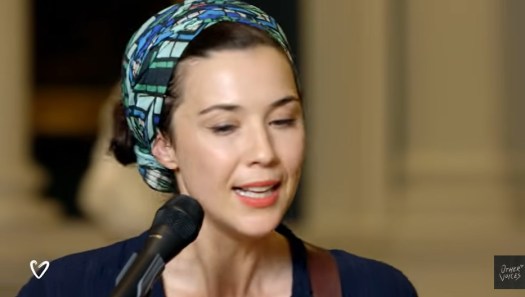
On Thursday 7th of May, Lisa Hannigan performed a magnificent, uplifting concert for you live from The National Gallery of Ireland. Enjoy this beautiful recording of ‘Undertow’ featuring Loah. You can watch the full live stream on the RTE Player now: bit.ly/2WnneVr Performances from Courage are being broadcast worldwide, free of charge, thanks to the support of the Department of Culture, Heritage and the Gaeltacht, Intel and RTÉ. Lisa Hannigan chose to highlight the work of Women’s Aid Ireland. If you can manage it today, please consider donating to: https://womensaid.ie/donate For more information on Lisa Hannigan check out: https://lisahannigan.ie/ About the National Gallery of Ireland: The National Gallery of Ireland is one of the country’s most popular visitor attractions housing the nation’s collection of European and Irish art from about 1300 to the present day, and an extensive Library & Archive. Entry to the collection is free for all to enjoy, learn and be inspired. Note: National Gallery of Ireland Closure The National Gallery of Ireland is currently closed, but there are countless ways for the public to engage with its national collection during this time. Initiatives include ‘National Gallery at Home’ videos, Work of the Day, Mindfulness and Art, and at-home activities inspired by the national collection. Virtual tours of iconic spaces such as the Shaw Room and the Grand Gallery, as well as recent exhibition Murillo: The Prodigal Son Restored, can also be explored from home. Find out more at http://www.nationalgallery.ie/national-gallery-ireland-at-home